
Gold With a Memory: Women, Rivers, and the Quiet Power of Artisanal Mining in Chocó
My name is Gizette Mosquera. I am the director of the Artisanal Miners’ Association of Chocó and an artisanal jeweler. The gold I transform into jewelry is the same gold that many women extract with their own hands along the banks of the San Juan River and the Atrato River. For us, gold is not an abstract commodity. It is part of our daily life, our rivers, our families, and our dignity.



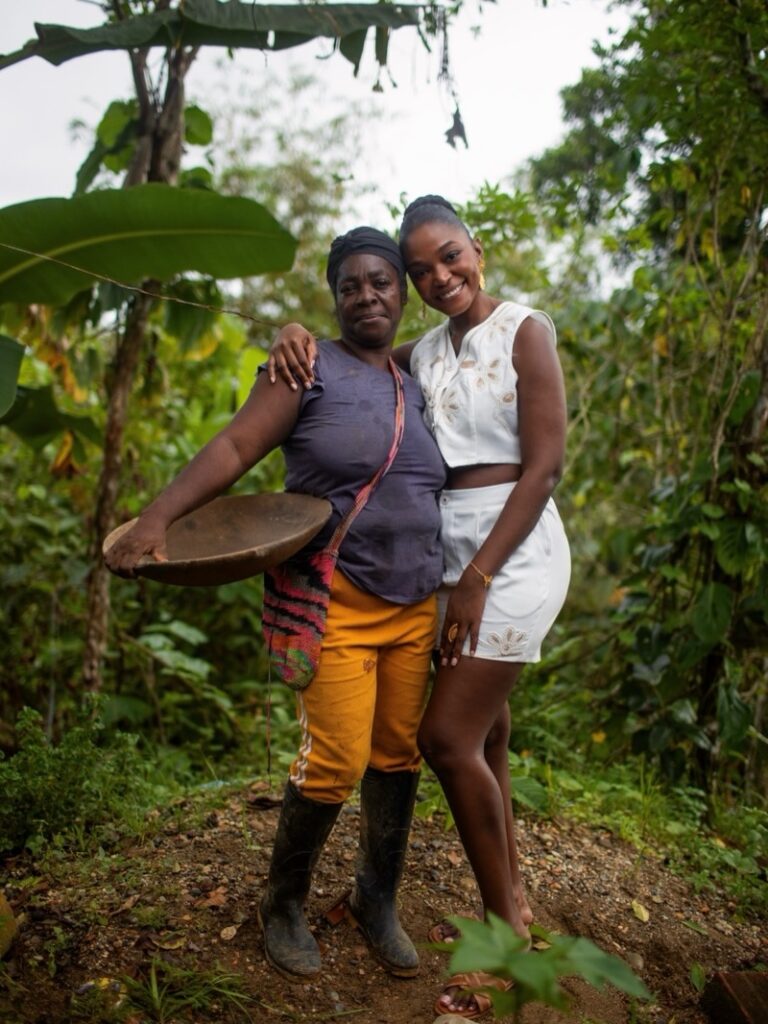
Photographer & Art Director – Black Gold Jeison Riascos/El Murcy
What Is Artisanal Mining?
Artisanal mining in Chocó is a small-scale, community-based practice that has existed for generations. It is carried out by families and local associations using traditional tools such as pans (bateas), wooden sluices, and hand shovels. There are no large excavators tearing apart entire landscapes, no industrial dredges altering riverbeds beyond recognition, and no corporate concessions displacing entire communities.
This form of mining is rooted in ancestral Afro-Colombian knowledge passed down through centuries. It is labor-intensive, yes—but it is also precise, controlled, and deeply connected to the rhythms of the river.
No Dangerous Substances
Responsible artisanal mining, as practiced by our association, does not use toxic chemicals such as mercury or cyanide. Instead, we rely on gravity separation techniques—washing sediment in wooden pans so that the heavier gold settles naturally at the bottom.
This method protects the waters of the San Juan and Atrato rivers, which are our drinking sources, our food sources, and our transportation routes. We understand that poisoning the river would mean poisoning ourselves. Our survival depends on the health of these ecosystems.
The Most Environmentally Friendly Form of Mining
Compared to industrial open-pit or mechanized mining, artisanal mining has:
Minimal land disturbance
No large-scale deforestation
No chemical contamination
Limited sediment displacement
Direct community oversight
Because the work is done manually and in small sections, the riverbanks can naturally regenerate. Vegetation grows back. Fish return. The impact is localized and reversible.
Industrial mining extracts wealth at massive speed and scale. Artisanal mining extracts with patience and responsibility. It prioritizes continuity over rapid depletion.
Safer for Communities
Artisanal mining keeps economic power within the territory of Chocó. Women, in particular, play a central role. Many of the gold producers along the rivers are mothers and heads of household. The income they earn supports education, food security, and local commerce.
There are no armed guards, no restricted zones, no displacement of entire villages. The miner is not separated from the land—they belong to it.
As a jeweler, I see the full circle: gold extracted by women’s hands becomes earrings, rings, and necklaces that carry a story of resilience. This is ethical gold. Gold with origin. Gold with community.
A Model for the Future
Artisanal mining, when organized, trained, and supported, is the friendliest and safest form of gold extraction for both the environment and the people of Chocó. It respects water. It respects territory. It respects culture.
We are not against development. We are against destruction.
The rivers of the San Juan and Atrato are living beings in our worldview. Protecting them is not activism—it is survival. And artisanal mining, done responsibly, proves that economic livelihood and environmental protection can coexist.
We are not against development. We are against destruction.
The rivers of the San Juan and Atrato are living beings in our worldview. Protecting them is not activism—it is survival. And artisanal mining, done responsibly, proves that economic livelihood and environmental protection can coexist.